Inside Rioja: Ancient Vineyards, Iconic Wineries and the Perfect Wine Weekend

Some wine weekends are enjoyable. Others are the kind of trips people are still talking about days after they've returned home.
Our Rioja Wine Weekend 2026 definitely fell into the second category.
At the beginning of June, twenty wine lovers from across Europe and North America arrived in Rioja, ready to spend three unforgettable days discovering the wines, landscapes and people that define one of Spain's most iconic wine regions.
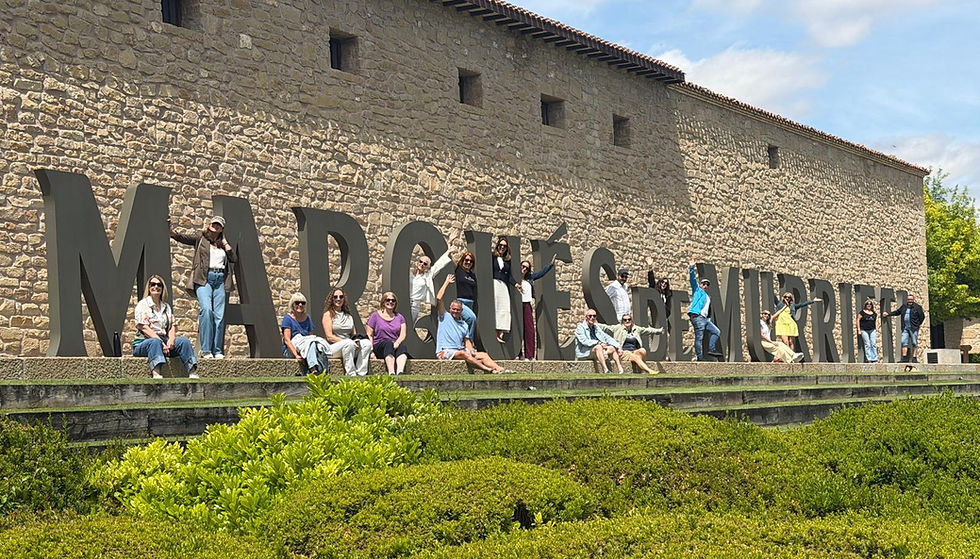
We visited ancient underground cellars, walked through historic vineyards, tasted wines from some of Rioja's most respected producers, enjoyed local cuisine and experienced the region at one of its most vibrant times of year.
From boutique family wineries preserving century-old vines to iconic estates whose names have helped shape Rioja's global reputation, the weekend offered a fascinating insight into the diversity that makes this region so special.
But when we look back on the weekend, it's not just the wineries or the wines that stand out.
It's the conversations over lunch. The laughs on the coach between visits. The friendships that formed between people who had never met before Friday morning.
Wine has a remarkable way of bringing people together, and Rioja proved to be a great setting for that to happen.

This is a look back at our Rioja Wine Weekend 2026.
Rioja is often regarded as the heart of Spanish wine, yet many visitors only scratch the surface of what the region has to offer. Beyond the famous labels lies a landscape of ancient vineyards, family-run wineries, medieval villages and a winemaking culture that has evolved over centuries. Our annual Rioja Wine Weekend was designed to showcase both the iconic names and the hidden gems, giving guests an authentic insight into one of Europe's great wine regions.
Logroño cathedral from the left side One of the famous pintxos you can find in Logroño. Mushrroms and prawns created by Bar Angel. An appropriate graffiti on an exterior wall in Logroño
Arriving in Logroño
Guests arrived from all corners of the globe and quickly settled into the relaxed atmosphere of Logroño.
English became the common language of this particular group, with Ivan occasionally stepping in whenever translation was required.
We had also timed our visit perfectly.
The city was preparing for San Bernabé, Logroño's most important annual festival, and the streets were buzzing with activity. Traditional costumes, music, food stalls and celebrations filled the city centre, providing a wonderful introduction to the region's culture and traditions.
After checking into the Eurostars Fuerte Ruavieja, our home for the weekend, it was time for our first winery visit.
Some of our wine weekenders getting ready to explore the many pintxos and tapas bars in Logroño A whole pig getting roasted for the weekend festivities in Logroño Some of our wine weekenders found a local bar in Logroño, which quickly became a favourite
Arizcuren: Preserving Rioja's Hidden Heritage
For our opening visit, we headed to Arizcuren, one of Rioja's most exciting small producers and a winery we began working with earlier this year.
Founded by Javier Arizcuren, an architect-turned-winemaker, the project focuses on recovering old vineyards high in the Sierra de Yerga. Some of these vineyards are more than a century old, and several contain traditional local varieties that might easily have disappeared without projects like this.
One theme we would encounter repeatedly throughout the weekend was the importance of preserving old vineyards, and Arizcuren provided our first glimpse into why that matters so much.
Listening to Javier's story, it quickly became clear that this isn't simply about making wine. It's about protecting a part of Rioja's viticultural heritage that could otherwise be lost.
Despite its relatively small size, Arizcuren has earned a reputation that extends far beyond Rioja. Today, the wines can be found on the lists of Michelin-starred restaurants around the world, a testament to both the quality of the vineyards and the vision behind the project.
Alongside the wines, we sampled the estate's olive oil and some surprisingly addictive truffle bonbons made using Arizcuren wine. The combination sounded unusual but worked beautifully.
One of the lighter moments came during a wax-sealing demonstration. After showing us how it's done, our host asked whether anyone would like to have a go. Faced with twenty reluctant volunteers, Ivan stepped forward and confidently took over. Judging by how smoothly he managed the task, it was clear this wasn't his first encounter with a wax seal.
The visit set exactly the right tone for the weekend: excellent wines, passionate people and fascinating stories.
A close up photo of a couplle of barrels at Arizcuren Ivan getting ready to show off his wax sealing skills A selection of Arizcuren wines on display Our first wine of the visit at Arizcuren The four wines we tasted at Arizcuren The tasting area at Arizcuren, with some of the group Our host pouring wine into glasses for the tasting part of our visit at Arizcuren Two high end wines displayed in individual boxes at Arizcuren Some of our group getting ready to tast e wines poured by our host at Arizcuren
Marqués de Murrieta: Where Tradition Meets Innovation
Friday morning gave us our first "wow" moment of the trip.
Most wine lovers have heard of Marqués de Murrieta. Seeing it in person is something else entirely.
The estate is stunning, the vineyards seem to stretch endlessly into the distance, and every detail feels carefully considered.
Hosted by Miriam Ochoa, Director of Visits and Hospitality, we explored the magnificent Castillo de Ygay, the surrounding vineyards and the winery itself.
Before arriving, many of us expected to hear plenty about history and tradition, which we got. However, what few of us expected was the level of technology operating behind the scenes.
Throughout the winery, sophisticated monitoring systems help track every stage of the winemaking process. Alongside the winemaking team works a dedicated tasting panel, continuously assessing the wines and helping determine the precise moment each wine is ready for bottling.
It was fascinating to see how comfortably innovation and tradition coexist. One moment we were hearing stories dating back generations; the next we were looking at technology that wouldn't seem out of place in a modern research facility.
The barrel room seemed to stretch endlessly into the distance, while the museum provided a fascinating journey through Rioja's history.
One display in particular caught our attention: a wall showing Murrieta's distributors around the world. For a group made up of guests from several different countries, it served as a reminder of just how far Rioja's reputation reaches.
Nearby stood an old red Murrieta delivery truck, creating a striking contrast between the winery's historic past and its modern global presence.
Our tasting afterwards included Pazo Barrantes 2022 from a Magnum, Marqués de Murrieta Reserva 2021 and Marqués de Murrieta Gran Reserva 2015.
Not a bad way to spend a Friday morning.
The start of our visit at Marques de Murrieta, with manicured lawns and an immaculate set up The iconic Marques de Murrieta sign within the grounds Marques de Murrieta vineyards, with the Rioja landscape in the background Taking a tour of the extensive grounds at Marques de Murrieta The famous Castillo Ygay white wine, encased in a protective see through box. Some of our group made some tempting purchases at Marques de Murrieta An iconic red delivery truck with the Marques de Murrieta logo painted on it The tasting room, with our whole group sitting down, ready to taste wines at Marques de Murrieta The three wines we tasted at Marques de Murrieta
Lunch at Finca de los Arandinos
Lunch at Tierra provided a welcome opportunity to slow the pace slightly.
Set amongst rolling vineyards, the restaurant offered the perfect setting to reflect on the morning's visit while enjoying a menu of local Riojan cuisine.
Croquetas, seafood salpicón and warm leek salad were followed by baked sea bream or slow-cooked beef cheeks braised in red wine. Dessert featured pears cooked in wine, almonds and cinnamon ice cream.
By this point, conversations around the table had become noticeably more relaxed. People were already comparing favourite wines, discussing previous wine travels and sharing stories from home.
It's always one of our favourite parts of these weekends: watching friendships begin to form naturally over a shared meal and a glass of wine.
Finca de los Arandinos from the garden Our wine weekenders in the dining room, ready to enjoy lunch at Finca de los Arandinos The white wine we enjoyed during lunch at Finca de los Arandinos Some of our group stretching the legs, after lunch at Finca de los Arandinos One of our group decided to completely relax after lunch at Finca de los Arandinos Looking down on some of the group in the garden at Finca de los Arandinos
Tritium: Five Generations of History Beneath the Streets
If Murrieta showcased Rioja at its grandest, Tritium revealed a different side of the region.
Family-run, deeply rooted in history and fiercely committed to preserving old vineyards, it quickly became a favourite for many guests.
Founded by Javier Fernández and Francisco Rubio, the winery focuses on vineyards that are over one hundred years old, some of which have been cared for by the same families for generations.
The restored 15th-century winery and underground cellars provided one of the most atmospheric visits of the weekend.
Walking through the historic facilities, it was easy to imagine how wine would have been produced centuries ago. The underground tunnels seemed to transport us back to another era.
Our host, the winemaker's daughter, delivered the tour with a wonderfully dry sense of humour, often at her father's expense, which kept everyone entertained from start to finish.
One particularly memorable group photograph was taken through the glass ceiling of one of the underground rooms. Our group squeezed into the cellar below while the photograph was taken from above.
The tasting featured five wines, including single-vineyard bottlings that highlighted the individuality of Tritium's historic vineyard sites.
Perhaps the most discussed wine was the underwater-aged bottling, which generated plenty of debate about how ageing conditions can influence a wine's development.
The Tritium wines proved so popular that many guests decided to take some home. Fortunately, Tritium offers free delivery for larger purchases, and several boxes arrived in Mallorca just days after our return to the island.
The Tritium entrance with the signage on the door Three barrels in a small cave at Tritium The entrance to the underground caves at Tritium Our group huddled into a small room with a glass ceiling The eye catching wine display in the underground cave at Tritium Some of our group enjoying a Tritium wine in the underground cave at Tritium One of the wines we tasted at Tritium - Marón Our host with her father and two of our wine group (who happen to be sisters) Two underwater wines on display at Tritium
Remírez de Ganuza: Innovation Through Precision
Saturday morning brought another Rioja icon.
The story of Fernando Remírez de Ganuza is one of vision, determination and a willingness to challenge accepted wisdom.
Before founding the winery in 1989, Fernando had already established himself as one of Rioja's leading vineyard experts. Yet what made the visit particularly fascinating was learning about the many innovations he introduced over the years.
Several were initially met with scepticism by more traditional voices within Rioja.
Today, many of those same ideas are widely recognised as important contributions to modern winemaking.
One of the most notable is the meticulous separation of the shoulders and tips of Tempranillo bunches, allowing different parts of the fruit to be used according to their quality and ripeness.
What sounds simple today was revolutionary when first introduced.
Again, we encountered an interesting contrast between tradition and innovation. Rioja may be famous for its history, but its evolution has often depended upon people willing to question convention and pursue quality in new ways.
The visit provided a fascinating insight into how a relentless focus on detail can shape the identity of a winery.
The Remirez de Ganuza sign at the entrance to the winery The two sisters in our group standing among the barrels at Remirez de Ganuza An overview of the Remirez de Ganuza winery An impressive display of stacked bottles in the cave at Remirez de Ganuza The grounds, with a water channel, at Remirez de Ganuza The three wines we tasted at Remirez de Ganuza Our wine group sitting down to a tasting at Remirez de Ganuza Three wines in glasses plus some charcuterie at Remirez de Ganuza Cheers! Some of our group enjoying one of the red wines at Remirez de Ganuza
Casa Primicia: Where Rioja's Story Began
From innovation, we moved to history.
Located in the medieval village of Laguardia, Casa Primicia is believed to be the oldest original active winery in Spain.
Walking through the tunnels and ancient stone chambers felt less like visiting a winery and more like stepping back through centuries of Rioja's history.
Originally constructed in the 11th century, the building later served as a collection point for church taxes before evolving into the winery it is today.
One object attracted particular attention from the group: an enormous old bota hanging from the ceiling. Viewed from certain angles, it looked remarkably like a pig suspended from the rafters, leading to plenty of double takes and more than a few photographs.
Lunch overlooking the Rioja Alavesa landscape was another highlight.
The menu included classic regional cuisine, such as Navarra asparagus, Rioja potatoes with chorizo, roast suckling lamb and a traditional Idiazabal cheese dessert.
The food was generous, the wines flowed freely and the hospitality perfectly reflected the warmth we had encountered throughout the region.
The staff also became increasingly concerned that one particular member of our group might somehow still be hungry and appeared determined to ensure he left fully nourished.
As lunches in Rioja often do, the meal concluded with generous servings of pacharán and a lot of laughs.
The Casa Primicia entrance in Laguardia One of our group, with a glass of wine in hand, looking down on some excations at Casa Primicia Two of our group enjoying the first wine we were given to taste at Casa Primicia Ivan and Lara, the hosts of the weekend, at Casa Primicia A display on Casa Primicia wines attached to a wall Two of our group admiring the giant bota suspended from a rafter at Casa Primicia The underground cave at Casa Primicia Two of our group on the steps leading down to the underground cave at Casa Primicia A display of wines on a wooden table supported by barrels at Casa Primicia One of our servers during lunch at Casa Primicia, with one of our group A group shot of our lunch table at Casa Primicia The server and one of our group who bonded during lunch at Casa Primicia
Maisulan: Biodynamics and the Landscape of Rioja Alavesa
Before our final winery visit, we were treated to a traditional Basque dance performance beside an ancient megalithic monument (Dolmen de la Chabola de la Hechicera in Elvillar), organised by Eva's daughter Grace.
Surrounded by a landscape shaped by thousands of years of human history, it served as a reminder that wine forms only one part of the rich cultural heritage of Rioja Alavesa.
Dolmen de la Chabola de la Hechicera in Elvillar Our group waiting to see the welcoming Basque dance known as Aurresku Strange cloud formations over the Riojan mountain range
Before a tasting at the winery, we visited a couple of Maisulan´s biodynamically farmed vineyards. Standing amongst the vines, surrounded by rolling hills and gently swaying wheat fields, it was impossible not to appreciate the beauty of the landscape.
The visit also provided valuable insight into the realities of biodynamic farming. While the philosophy often generates discussion amongst wine lovers, seeing the vineyards firsthand helped us understand both the commitment and practical challenges involved.
Back at the winery, we tasted Maisulan 6, Maisulan 12, Txabola Graciano and Viura before raising a final glass to an extraordinary weekend.
Visiting one of the biodynamic vineyards at Maisulan A close up photo of the vines at Maisulan, with the Rioja mountain range in the distance Eva talking to one of our group, among the Maisulan vines Three of our group at Maisulan winery, waiting for the tasting to begin Three wines we tasted at Maisulan Each member of our group was given a homemade cookie at the end of the Maisulan visit.
A Reflection on Rioja's Future
Conversations that came up repeatedly throughout the weekend stayed with us after we returned home.
At several wineries, we heard concerns about the future generation of vineyard workers and winemakers. Many family businesses are finding it increasingly difficult to persuade younger people to follow the same path as their parents and grandparents.
Standing amongst some of Rioja's oldest vineyards, it was easy to understand why this matters.
The landscapes we enjoyed throughout the weekend have not appeared by accident.
The old vines, stone terraces, villages and wineries are all the result of generations of people caring for the land, often through physically demanding work that receives little recognition from those of us simply enjoying the finished bottle.
We visited vineyards that have survived for more than a century. We met families who have dedicated their lives to preserving them. We heard stories of people investing in the future, rescuing forgotten vineyards and refusing to let valuable traditions disappear.
It was impossible not to leave with a deeper appreciation for the people who make these landscapes possible.
Despite the challenges, what gave us confidence was the passion we encountered everywhere we went.
From Javier Arizcuren's commitment to recovering historic vineyards, to Tritium's dedication to preserving old vines, to producers continuing to invest in sustainable and biodynamic farming, there was a shared determination to protect Rioja's future.
Hopefully that same passion will inspire the next generation in the years ahead.

Until Next Time, Rioja.
As Sunday morning arrived, guests began heading in different directions. Some travelled to airports, others continued their adventures through Spain, while we made our way back via Bilbao and ultimately home to Mallorca.
As we travelled home, many questions arose...
Which winery was your favourite?
Which wine will you be ordering when you get home?
Would you go back to Rioja?
Looking back, Rioja gave us everything we could have hoped for. Great wines, fascinating stories, beautiful landscapes and generous hospitality wherever we went.
But as always, it was the people who made the difference.
Over three days, complete strangers became friends. Conversations flowed between people from different countries, cultures and professions, united by a shared curiosity about wine and a willingness to embrace new experiences.
For us, that's what our Wine Weekends have always been about.
The wineries provide the setting.
The wines start the conversations.
The people make them unforgettable.
And now comes the important question...
Where should we go next?
The photos in this article are a selection taken by us and our wine weekend group.


Comments